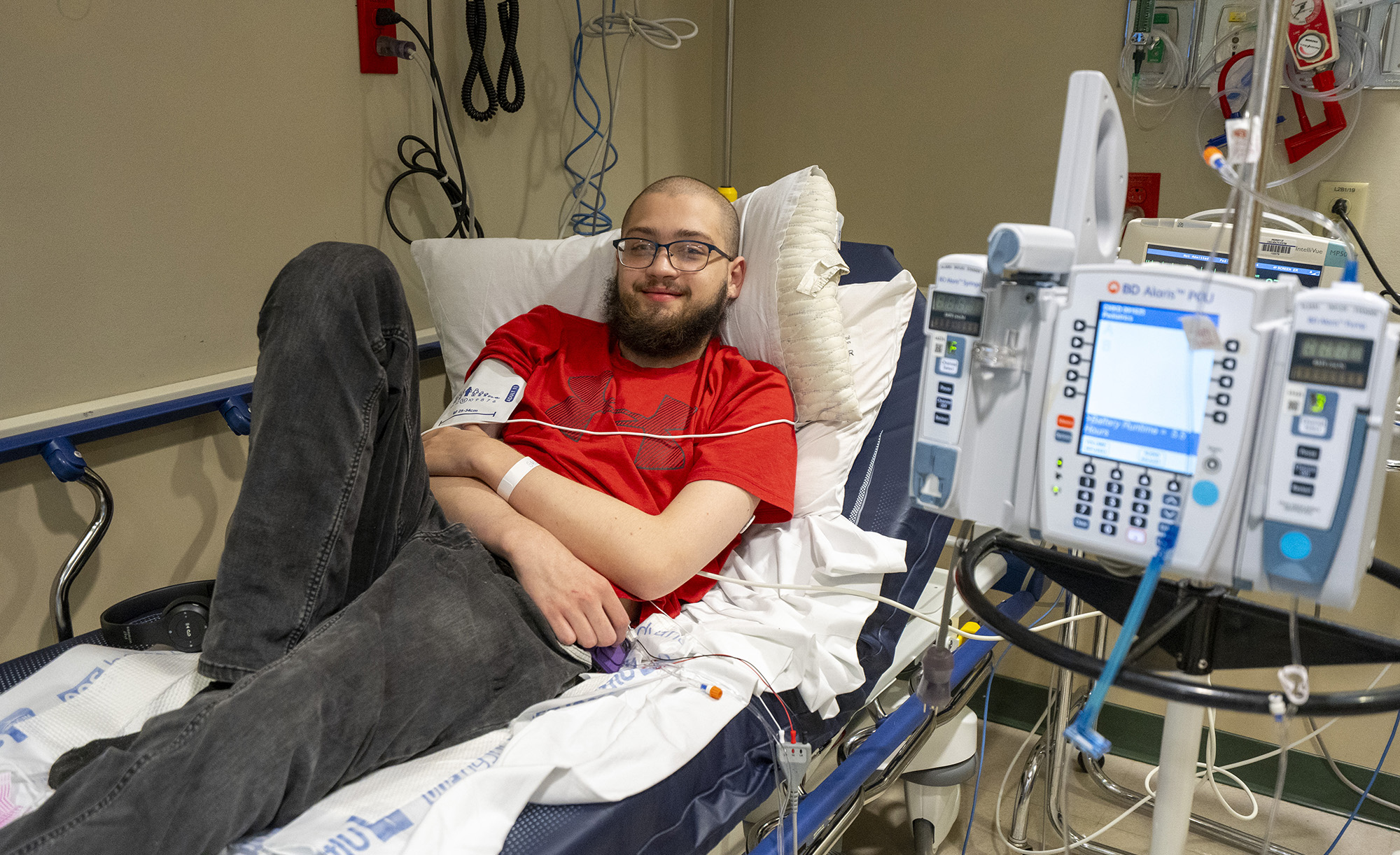
Facing leukemia on top of cystic fibrosis, Adam finds healing as CHKD’s first patient to receive groundbreaking CAR-T cell therapy
The pain started in Adam Wiscarson’s back – an ache so severe he couldn’t sleep. Within days, it worsened. He couldn’t eat. He couldn’t drink. Nothing stayed down. When he went to an emergency department near his home in Yorktown, he received a diagnosis he never expected: he had cancer.
Adam, who was 20 at the time, was transferred immediately to CHKD, a place that was already very familiar to him. Since he was a toddler, Adam has received treatment at CHKD for cystic fibrosis, a genetic disease that can cause life-threatening lung infections, liver disease, pancreas issues (including diabetes), and gut problems, all of which Adam has endured. Now, he was facing another devastating illness.
Lying in a hospital bed at CHKD, Adam tried to process the news. He thought about his mom, who had died of cancer just a few years earlier. He worried about his own survival and the toll it could take on his family members. Then, he met his oncologist, Dr. Linda Pegram, who gave him some hope. The type of cancer Adam had – acute lymphoblastic leukemia (ALL) – was potentially curable.
“I was so relieved,” Adam says. “I started breaking down in the hospital room.”
What Adam couldn’t have known at the time was that in less than a year, he would become the first patient at CHKD to receive CAR-T cell therapy, a groundbreaking treatment that genetically engineers a patient’s own T cells to recognize and destroy their cancer cells.
At this time, CAR-T therapy isn’t a first treatment option for patients. The Food and Drug Administration has approved it for patients whose leukemia returns or doesn’t respond to standard treatment.
From the beginning, Adam’s diagnosis carried added risk because of his age and the high-risk genetic features of his leukemia cells. Additionally, Adam’s cystic fibrosis multiplied his risk when receiving conventional therapy. These treatments came with potential side effects for his organs, such as his liver, lungs, and intestinal tract, which were already affected by his cystic fibrosis, according to Dr. William Owen, pediatric hematologist and oncologist, and division director of the Children’s Cancer and Blood Disorders Center at CHKD.
First, Adam had induction chemotherapy, designed to push him into remission, but it became clear the treatment hadn’t worked.
“We gave him two more months of what’s called consolidation chemotherapy, hoping he would be in remission at the end of that,” says Dr. Pegram. “But he still had detectable disease.”
The next step was blinatumomab, an immunotherapy that triggers the immune system to attack leukemia cells.
“We didn’t know whether it was going to work,” Dr. Pegram says. “But thankfully, it worked beautifully. It put Adam into a deep remission and kept him there. He had no detectable leukemia cells after one cycle of blinatumomab, so we continued this treatment for a total of four cycles, based on clinical trial results for young adults with ALL.” With his cancer finally under control, Adam could begin preparing for what came next: CAR-T cell therapy.
Historically, he would have proceeded next to a bone marrow transplant to treat refractory ALL, but Adam had no matched family donors. The risks of using an unrelated donor, given the underlying organ dysfunction from his cystic fibrosis, were simply too high.
CAR-T cell therapy was by far the best treatment option for Adam.
First, Adam’s T cells, a type of white blood cell that helps the body fight infection, were collected by the American Red Cross at CHKD during a process called apheresis. The cells were then shipped on dry ice to Philadelphia for cryopreservation before being sent to a Novartis manufacturing plant in New Jersey, where they were genetically modified and programmed to find and attack his cancer cells. Over several weeks, the lab grew millions of these new cells and stored them until Adam was ready for his infusion.
Before receiving the engineered T cells, Adam had a short course of chemotherapy to further suppress his own immune system so the CAR-T cells could grow, stay active, and effectively kill cancer cells. Without chemotherapy, the CAR-T cells wouldn’t work well because his body’s immune system would overpower them.
On the day of his infusion, Adam waited with his brother in a patient room inside the hospital’s cancer clinic as his care team meticulously thawed his CAR-T cells. Despite its medical innovation, the treatment resembled a simple blood transfusion. However, for the team, it was a historic milestone after years of effort to bring CAR-T cell therapy to CHKD.
“It’s just exciting to be able to do this here without having to send Adam elsewhere,” Dr. Pegram says. “He’s been followed at CHKD his whole life because of his cystic fibrosis, so all his subspecialists are here. Everyone who knows him, who cares about him – they’re all here. It’s also easier for his family, logistically.”
Throughout Adam’s cancer journey, his care required an extraordinary level of coordination. He relies on the medication Trikafta because of his cystic fibrosis. Trikafta is a combination of three drugs that work together to fix the protein that doesn’t function properly due to the inherited genetic mutation that causes CF. However, this medication had to be paused and adjusted multiple times during his cancer treatment due to liver damage.
Managing his medical needs required constant communication among CHKD specialists in oncology, pulmonology, infectious diseases, endocrinology, and pharmacy. Dr. Pegram collaborated closely with Dr. Laura Sass, Adam’s infectious diseases specialist; Dr. Cynthia Spoolman, his pulmonologist; and Sarah Parsons, the clinical pharmacist who oversees his Trikafta treatment. “It’s really been a group effort,” says Dr. Pegram. “That’s part of the reason it was so important for him to be able to do CAR-T cell therapy here.”
A critical part of the CAR-T cell therapy was making sure Adam stayed close to CHKD for two weeks after his infusion in case he experienced any side effects, which could require immediate hospitalization. He attended daily follow-up visits at the cancer clinic.
Thankfully, Adam hasn’t faced any serious issues. All tests have returned the same result – no evidence of cancer.
Today, Adam’s health continues to improve. He’s been able to resume his Trikafta treatment, and he remains grateful for all the care he’s received at CHKD and for the opportunity to get CAR-T cell therapy so close to home.
“It would have been much worse for me if I had to leave the area to have CAR-T cell therapy,” Adam says. “Everyone has been great. I love CHKD.”
For Dr. Owen, witnessing Adam’s progress has been extraordinary. “He’s doing fabulous,” says Dr. Owen. “It’s just been remarkable. A big part of treatment success is a patient’s attitude and drive. Adam is beyond belief in terms of his attitude.”
Published in CHKD’s KidStuff Magazine, Summer 2026
Written by Alice Warchol • PHOTOGRAPHY by Ken Mountain