

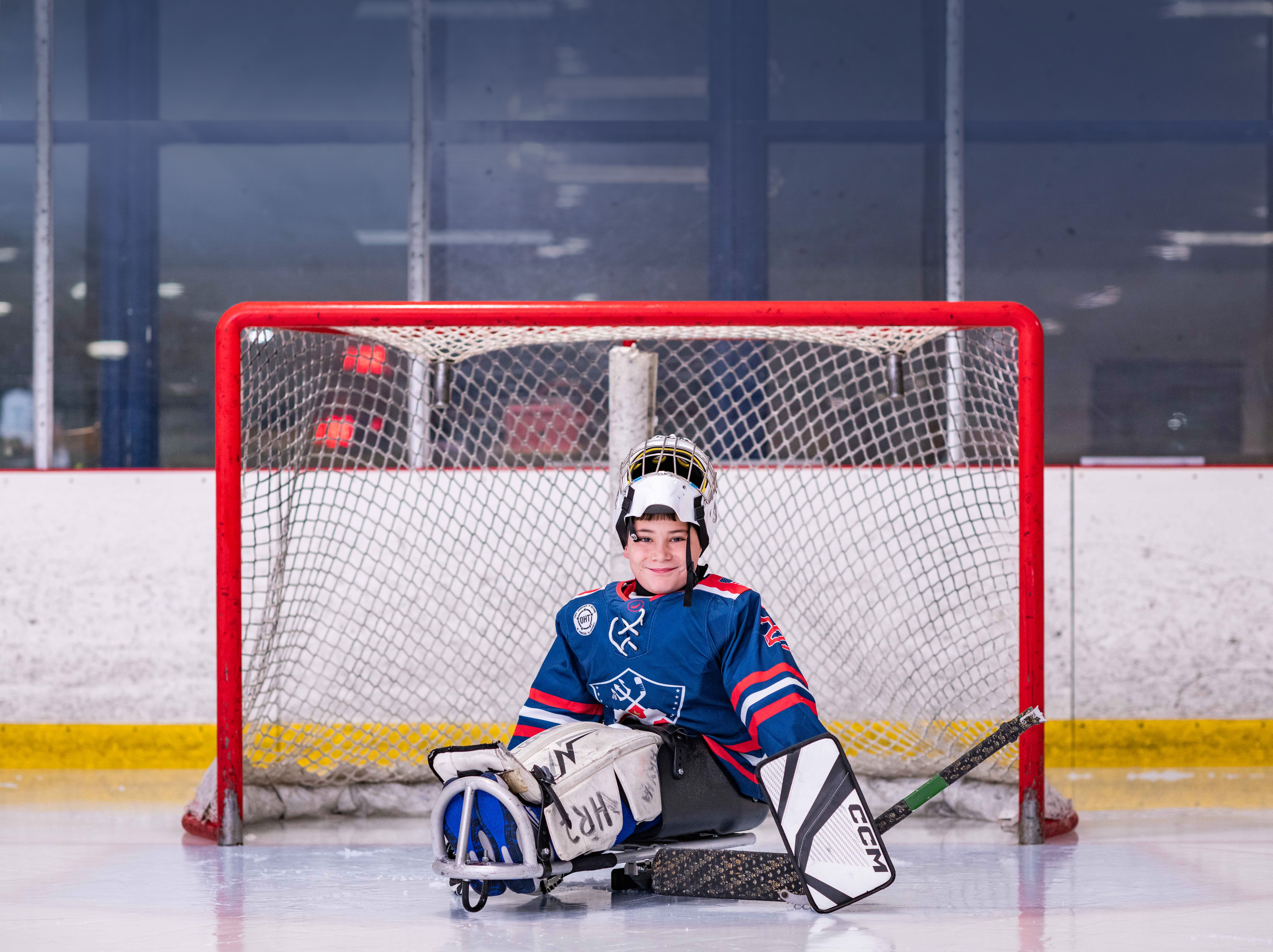
Ten-year-old with spina bifida breaks through physical barriers to play hockey
Daniel Izzo doesn’t let anything slow him down.
At 10, he’s tackled more than most adults: 12 surgeries, countless appointments, and the daily mobility challenges that come from living with myelomeningocele, a form of spina bifida. But the young sports fan would much rather focus on what he can do – like adaptive ice hockey – or dream up something entirely new like wheelchair football.
Each year in the U.S., one in nearly 3,000 babies are born with spina bifida, a birth defect that occurs when the spinal cord doesn’t fully close during fetal development. Daniel, who was diagnosed at birth, was less than 24 hours old when he underwent neurosurgery to close the opening in his back and have a shunt placed in his brain to help drain spinal fluid. Daniel and his family soon moved to Virginia Beach to be closer to family, transferring his care to CHKD. “He’s been with CHKD practically his whole life,” says his mom, Jackie.
Daniel is a welcome visitor at CHKD’s Spina Bifida Clinic, a multidisciplinary program that streamlines care for patients by bringing different providers together in a single place for one extended visit, instead of asking the patient to make individual trips to see each one. “I still remember preparing for our first visit, packing snacks and coloring books. It was a long day, but it was smooth,” says Jackie. “The clinic is amazing.”
The Spina Bifida Clinic brings together surgical and medical specialists from neurosurgery, urology, orthopedics, physical medicine and rehabilitation, and developmental pediatrics, along with support services such as nutrition, adaptive seating, and physical therapy. Visits often begin with imaging such as MRIs, X-rays, and ultrasounds, followed by appointments with each provider. The team collaborates in real time, which keeps care efficient and reduces stress on families. Last year, children made more than 200 visits to CHKD’s Spina Bifida Clinic.
Daniel’s longtime physical medicine and rehabilitation provider, Dr. Charles Dillard, has treated Daniel since he was a preschooler. “Daniel is a wonderful kid with lots of friends, and has a very involved family,” says Dr. Dillard. “Kids with spina bifida can face challenges involving muscle control, bladder and bowel function, and changes with growth. When old people like me get hurt, we just stop doing stuff. The nice thing about kids, especially ones like Daniel, is they figure out ways around those limitations.”
“We never treated him differently and we encouraged him to do things himself,” says Jackie. “I think that’s what really pushed him to be where he is now.”
Daniel has played basketball, tennis, and baseball, but a new passion sparked when the family discovered the Warrior for Life Fund adaptive sled hockey program. At the time, it was only for adults, but Daniel soon became the first kid on their team.
While Daniel may use a wheelchair permanently and have limited sensation from the mid-shin down, having mobility challenges doesn’t mean he has to miss out on the fun. He can sit in a specially designed sled with two blades underneath and use sticks with metal picks to propel himself across the ice. And Daniel loves playing goalie – just as long as they don’t slap the puck too hard at him. He’s even scored two goals.
“I call him my wild child,” says Jackie. “He has no fear!”
His fearlessness is a trait his doctors admire. “Daniel is able to participate in so many activities because he never lets his limitations curtail his ability to do things,” says Dr. Dillard. “He just doesn’t take no for an answer.”
Published in CHKD's KidStuff Magazine, Fall 2025
Written by Jessica Davenport • Photograph by Amanda MacDiarmid