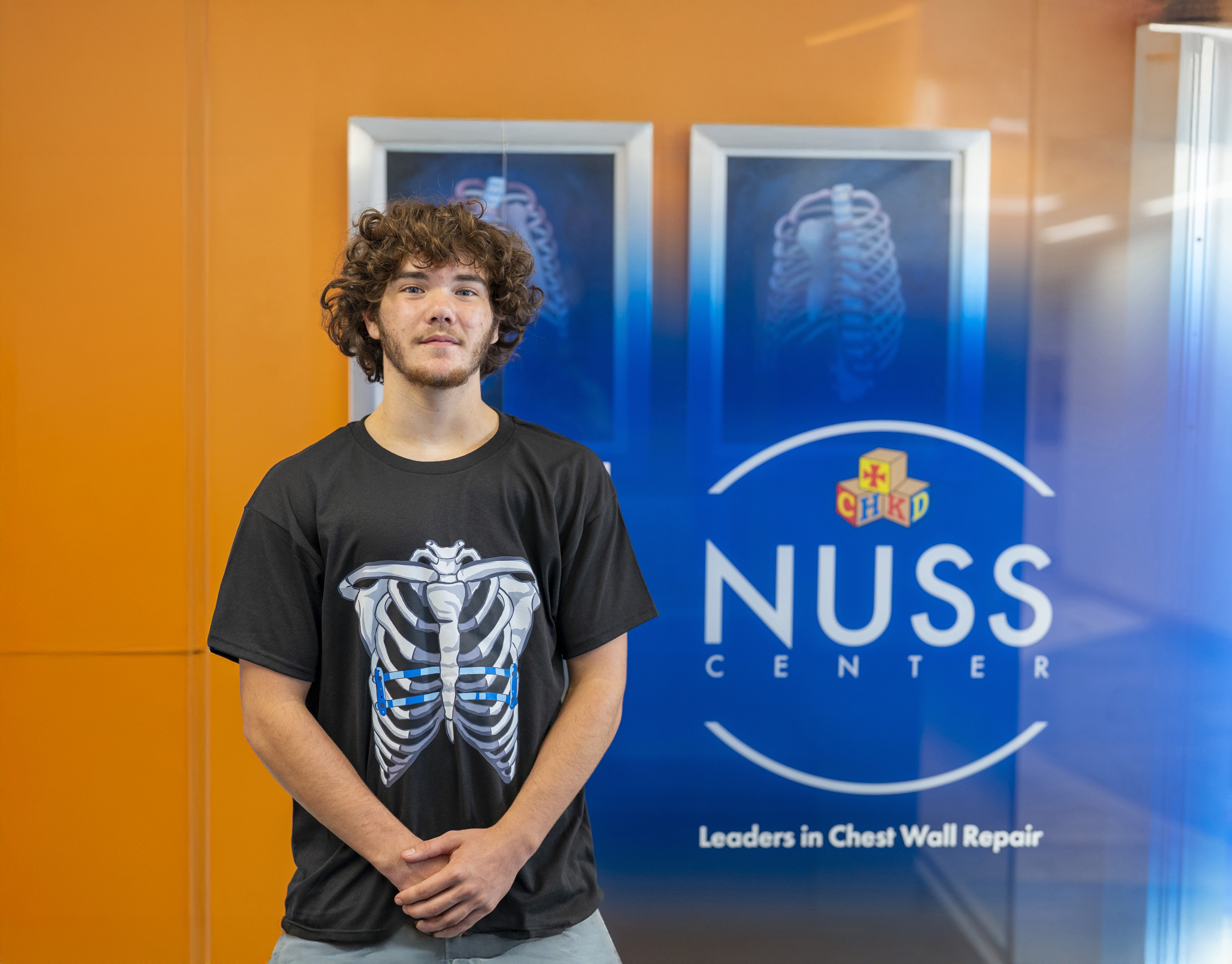
Thomas Marlowe-Santiago finds new confidence after chest wall reconstruction and years of specialty treatment at CHKD
Thomas Marlowe-Santiago has been coming to CHKD since the day he was born, when doctors in the delivery room noticed something odd about his heartbeat: it was loudest on the right (or in this case, wrong) side of his chest.
Thomas has a condition called situs inversus, which means his internal organs are on the opposite side of the body from those with normal anatomy. This mirror-image flip is one aspect of a genetic condition that Thomas has called Kartagener syndrome, which also involves dysfunction of cilia, tiny hair-like structures that are essential for a wide range of functions in the body. In Thomas’ case, this dysfunction causes him to experience frequent respiratory and sinus infections.
Since his first transfer to CHKD’s Neonatal Intensive Care Unit, Thomas has been hospitalized at CHKD several additional times for pneumonia and bronchitis. Over his 16 years, the Virginia Beach teen has been treated by a host of specialists at CHKD, including pulmonologists; cardiologists; ear, nose, and throat surgeons; and allergy, asthma, and immunology specialists. He does physical therapy every day, wearing a special vest that vibrates to help dislodge mucus and keep his lungs clear. He also takes medications for asthma and allergies.
But that’s not all this brave young man has had to deal with. He also has Poland syndrome, which is characterized by a missing pectoralis muscle, in his case on his left side. And, as a teen, Thomas developed pectus excavatum, a condition in which the chest wall sinks in toward the spine.
Fortune was on Thomas’ side in another respect, however. His hometown, go-to hospital that has treated him since birth just happens to be the top international center for the treatment of pectus excavatum.
Being able to receive comprehensive care across many specialties in one place – one that’s just for children and teens – has been a lifesaver for Thomas and his family. “If it weren’t for CHKD, my son wouldn’t be here,” says Thomas’ dad, Brian LaRose.
CHKD’s leadership in the field of pectus excavatum started in the 1990s, when Dr. Donald Nuss and his CHKD colleagues developed a minimally invasive procedure to reshape the chest wall of patients with pectus excavatum. Known as the Nuss procedure, the technique has become the preferred method to correct pectus excavatum throughout the world. And now that most children’s hospitals offer the Nuss procedure, CHKD has become known for handling the most complex cases of pectus excavatum and for international collaborations that have advanced the field of chest wall reconstruction.
“A child who comes to CHKD for chest wall reconstruction today has many more options than children did even a decade ago. From cranes and more hardware choices that help us manipulate the chest wall in the operating room, to non-surgical interventions that use suction or bracing, our surgeons are versed in all of the latest techniques so we can offer the best choice for each patient based on their condition, preferences, and lifestyle,” says Dr. Michael Goretsky, division chief for Pediatric Surgery and co-surgical director of the Nuss Center.
Thomas’ case definitely fell into the “most complex” category, says CHKD surgeon Dr. Franklin Margaron, who treated Thomas. “Thomas’ muscular asymmetry and underlying respiratory issues presented challenges,” says Dr. Margaron. “When you and I inhale, our sternum expands outward,” he explains. “Thomas’ sternum rotated inwards toward his heart and lungs when he inhaled.
“Severe pectus excavatum like Thomas’ can cause direct cardiac compression, which can lead to valvular dysfunction, arrhythmias, and a number of different problems,” says Dr. Margaron. “For Thomas, that would have potentially led to shortness of breath and inability to engage in activities he would otherwise be able to do.”
In addition, the chest can be very sensitive for weeks after the Nuss procedure. Surgeons use curved metal bars that go under the sternum and are affixed to ribs to press the sternum and ribs out into a normal shape. The bars remain in place for several years while the chest wall matures and hardens.
Dr. Margaron was concerned that the agitation from Thomas’ compression vest might be very painful, or even dislodge the Nuss bars from their proper position. But if Thomas doesn’t use his vest every day, he risks developing lung infections, including pneumonia.
“Thomas’ unique physiology called for a dramatic degree of correction combined with the most stability we could offer,” says Dr. Margaron.
For Thomas, Dr. Margaron opted to use a system of surgical instruments and implants developed in Korea by Dr. Hyung Joo Park. The Park system is a variation of the Nuss procedure that uses additional bars and a different system of anchoring them to offer additional stability.
Thomas went into surgery on December 20, 2022. “This was the first major surgery that my son ever had. I was petrified that something would go wrong,” says Lisa LaRose, Thomas’ mom. “But Dr. Margaron made Thomas very comfortable. He also kept checking on us, letting me know that Thomas was OK.”
Brian shares Lisa’s gratitude for Thomas’ care at CHKD: “Everybody in the hospital was checking on him, and my wife and me, making sure we had something to drink, to eat, pillows and blankets, what we needed as the parents,” he says. “From the cafeteria workers to the cleaning crew, nurses, and doctors, everybody I came across was very friendly and courteous.”
Thomas recalls being nervous before surgery, but happy afterward: “I trusted the doctors; I knew I had the top doctors working on me. I remember feeling happiness and relief when I woke up from surgery.”
Thomas was discharged from the hospital on December 24. “Our Christmas miracle,” Lisa says. In the next few months, he noticed a marked improvement in his physical capabilities. “My balance got better. I could take a deep breath. I was able to run for longer,” he says. “My strength started coming back, and I was able to build more muscle.” Before surgery, having no pectoralis muscle on his left side meant Thomas’ sternum rotated severely in that direction. It kept him from strength training. Now, Thomas goes to the gym daily. “My self-confidence skyrocketed,” he says.
That positive emotional boost is a common side effect of chest wall reconstruction.
Many patients with uncorrected pectus excavatum experience negative body image that can lead to avoiding activities or obsessing over their appearance. “Before his surgery, Thomas went through a rough spot where he didn’t like the way he looked,” says his mom. “That was really the main reason why we sought the referral to the Nuss Center.”
“There is usually a significant psychological change in patients,” says Dr. Margaron. “Patients gain more than the ability to breathe more comfortably. They gain confidence. It changes the trajectory of an individual’s future and the way they feel about themselves.”
Thomas will have the bars removed when he is 17, three years after his initial surgery. After that, he plans to consult with a plastic surgeon on options to minimize the look of his missing pectoralis muscle. He will also continue to follow up with his pulmonologist to keep his lungs as healthy as possible.
But Thomas is happy with his results today. “The surgery has improved the way I look and feel. I feel normal,” he says. “It’s definitely worth it.”
Published in CHKD's KidStuff Magazine, Fall 2025
Written by MaryClaire Hudson • Photograph by Ken Mountain