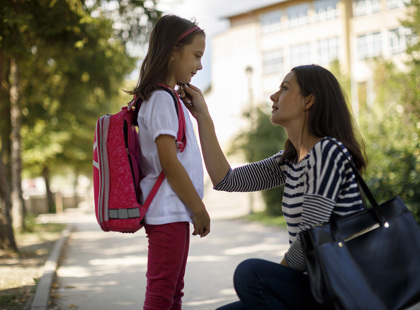
One of the most popular CHKD parenting webinars is Positive Discipline. Parents and providers who attend the class are often looking for ways to reduce their own frustration when their children or students are uncooperative or “testing the limits!” Ultimately, we aim to raise children who have the capacity for self-discipline and impulse control.
Learning some basics about brain science can help us understand why children do what they do and why it is important to keep our composure when we are teaching them critical skills for cooperation, conflict resolution, and decision-making.
Tip #1 – Children’s brains are a work in progress.
The brain develops from the back to the front and from the bottom to the top. The last part of the brain to fully develop is the thinking part (the frontal cortex). Have you ever uttered the phrase, “What was my child thinking?” Well, they weren’t thinking. Their brain is still growing. They learn cause and effect early on: when I do this, I get that. However, the complex thinking required to discern whether something is a good idea is under construction throughout childhood. The brain is not fully developed until early adulthood. There are a few ways we can help children develop critical thinking skills:
Be patient.
Provide consistent routines. The brain is pattern-seeking.
Provide clear expectations. Believe it or not, children are more likely to cooperate when expectations are clear.
Use a when-then scenario. For example, “When your homework is finished, then you can have 30 minutes of screen time.”
Tip #2 – When children feel calm and connected, they have access to the thinking part of the brain.
When a child is feeling stressed, pressured, overtired, or overstimulated, we might see frustration, whining, or aggression. The thinking part of the brain has gone offline. A stressed child is unlikely to appreciate our corrections or feedback while in the middle of an upset. Dr. Dan Siegel suggests we consider the 3 Rs to build brain capacity and a supportive parent-child relationship. We help the child regulate, relate to their point of view, and guide or support them in reasoning. What might that sound like?
Regulate: Take a deep breath. I am here to help.
Relate: It seems like this is really important to you. Tell me about it.
Reason: How can I help? Maybe we can make a list of options.
To develop important self-discipline skills, they need to strengthen the thinking part of the brain. Children can learn from our example and guidance, but they also need to practice honing their self-regulation skills. I have a friend who tells her children, “Practice makes progress!” She also reminds me that parenting is a work in progress: “Patience takes practice, too.”
Tip #3 – Composure is key.
When our children are uncooperative or out of control, we must hold fast to our composure. They borrow from our composure until they develop their own emotional and brain maturity. When we model composure, they feel safe expressing everything that’s going on with them. We get a glimpse into their world, and they learn to trust us. When we lose our composure and scare or hurt our children, it can create a disconnect that is hard to repair. Parenting can be difficult. Keeping our composure when our child is out of control takes practice, but it’s definitely worth the effort.
Positive discipline focuses on building the architecture for healthy brain development and the foundation for a positive, lifelong relationship between children and the important adults in their lives.
For more information on Positive Discipline or to register for an upcoming webinar, visit CHKD.org/ParentingResources